

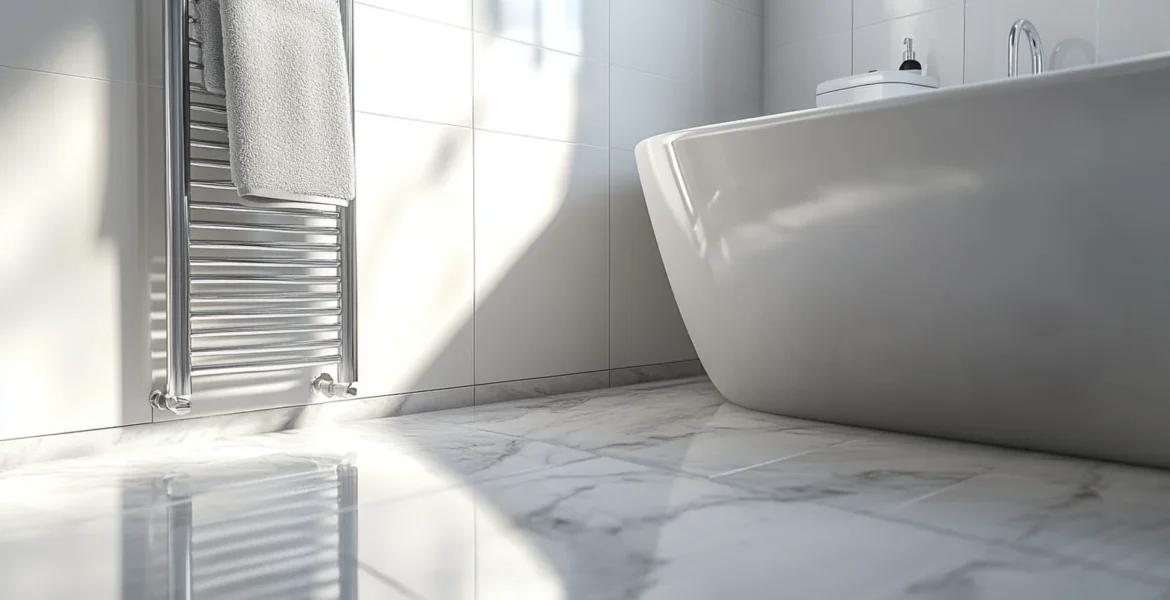
Bathroom Underfloor Heating: Is It Worth It?
Stepping onto a warm tiled floor on a January morning is the single most persuasive argument for underfloor heating, and no specification sheet conveys it. It is also the reason it comes up in most bathroom renovations we quote for, usually as a question rather than a decision.
Bathroom underfloor heating is genuinely worth fitting in a lot of UK homes, but not all of them, and the deciding factors are less about cost than people assume. Floor build-up, the finish you want, and how the room is actually used matter more than the headline price.
Electric or Wet: The Two Systems
Electric bathroom underfloor heating uses a thin heating cable, usually supplied on a mesh mat, laid across the floor and covered in levelling compound or tile adhesive. It is thin, it responds quickly, and in a room the size of a typical bathroom it is straightforward to install.
A wet system circulates warm water through pipework in the floor, fed from the central heating. It is more efficient to run, particularly with a heat pump, but the pipework and screed add considerable depth and it makes far more sense across a whole floor than in one small room.
For a single bathroom in an existing house, electric is almost always the practical answer. For a bathroom forming part of an extension or a whole-floor renovation where the screed is going down anyway, a wet system becomes worth considering.
What Bathroom Underfloor Heating Costs to Run
The bathroom underfloor heating running cost question usually comes with an assumption that it will be expensive, and the honest answer is that it depends almost entirely on how it is controlled.
An electric mat in a bathroom is a relatively small load, and a bathroom is a small room used in bursts. Run on a timer for a couple of hours around the times the room is actually used, the cost is modest. Left running continuously through winter, it is not.
The comparison people should make is not underfloor heating versus nothing. It is underfloor heating versus the towel rail or radiator it partly replaces, and against the comfort gained. The Energy Saving Trust guidance on home heating is a useful neutral reference on how heating choices affect consumption.
How electric underfloor heating is installed
A bathroom underfloor heating mat is rolled out across the floor area, avoiding anything fixed to the floor such as the WC pan or a floor-standing vanity, since heating under a fixed unit is wasted and can cause problems. The cable is never cut, so the mat is cut and turned to fit the shape of the room.
A floor sensor probe is set into the floor between two cable runs, ideally in a conduit so it can be replaced if it fails. That detail is skipped surprisingly often, and a probe set directly into adhesive with no conduit is unrecoverable.
The cable is then covered, either with a self-levelling compound or directly in the tile adhesive bed, and the floor finish goes on top. The electrical connection runs back to a fused spur and thermostat, and because it is a new circuit in a bathroom it is notifiable work needing certification.
Floor build-up and door clearances
This is the constraint that catches people out. Insulation board, heating mat, levelling compound, adhesive and tile all add up, and the floor can easily rise by 25mm to 40mm depending on the specification.
That has consequences. The door may no longer clear the floor and need trimming. The threshold to the landing becomes a step. In a room where the existing floor already sits high, it can push things past what is comfortable.
Measure the door bottom, the threshold and any fixed items before committing. It is an easy check at survey stage and an awkward discovery once the mat is down.
Insulation board and why it matters
Laying bathroom underfloor heating straight onto a cold concrete slab means heating the slab as well as the room, and a slab is a very large heat sink. Insulation board under the mat directs the heat upwards instead of downwards.
It makes a substantial difference to both warm-up time and running cost, and it is the component most often left out to save money. That is a false economy: the saving is small and it is paid back in slower heat-up and higher consumption for the life of the floor.
On a timber floor the argument is slightly different but the principle holds. Insulating below the heat source is what makes the system responsive rather than sluggish.
Which floor finishes work
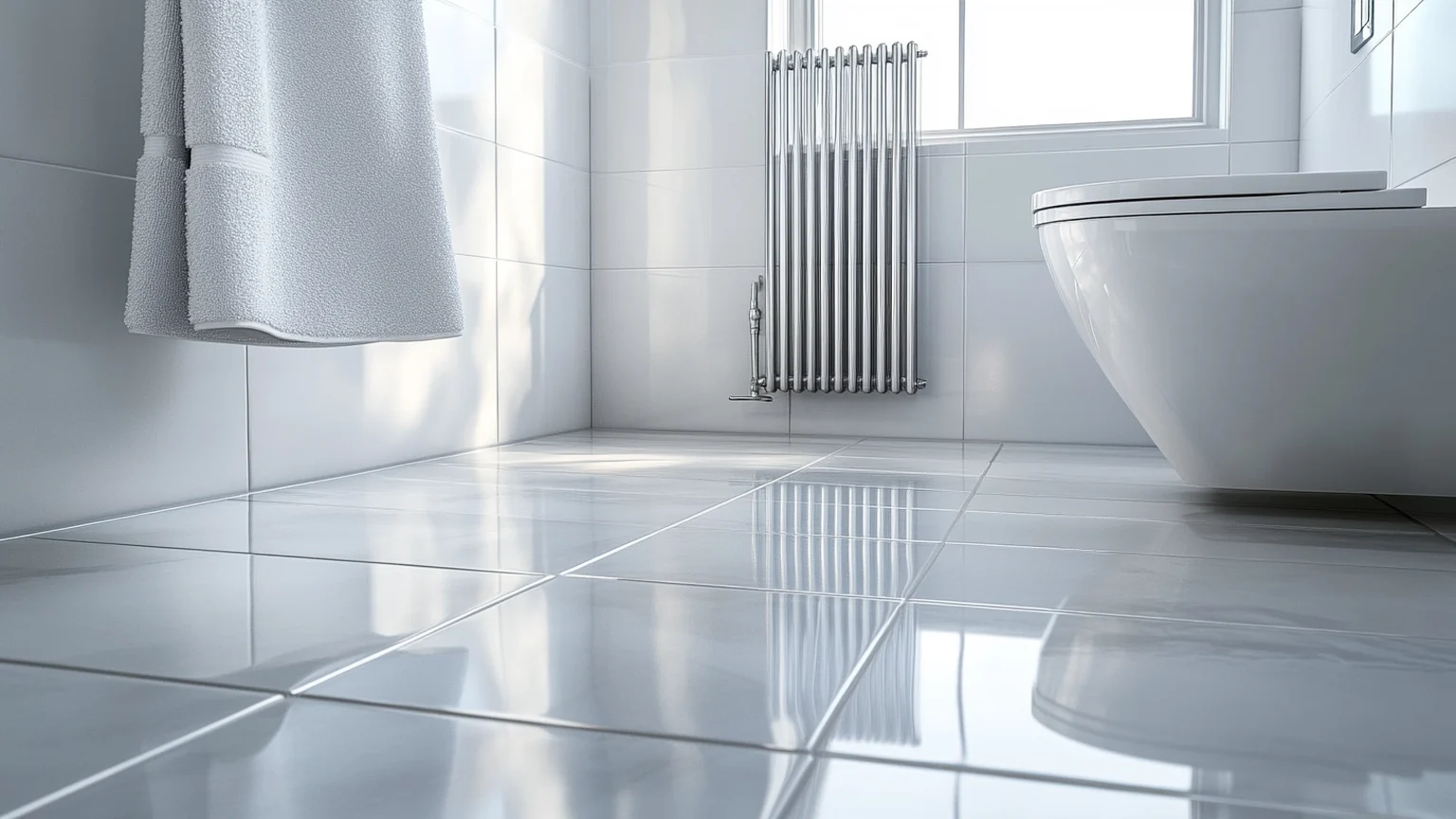
Porcelain and ceramic tile are the natural partners for bathroom underfloor heating. They conduct heat well and are dimensionally stable, so they transmit warmth efficiently and do not object to the temperature cycling.
Natural stone works too and holds heat longer, though it takes longer to warm up. Rigid core vinyl and quality LVT are usually compatible, but the manufacturer will specify a maximum floor surface temperature and that limit must be respected.
Solid timber is the awkward one. It moves with temperature and moisture, and in a bathroom it is already working hard. If you want a timber look over underfloor heating, an engineered board rated for the purpose, or a convincing tile, will cause fewer problems.
Controls and running it sensibly
The thermostat does more for running cost than any other component. A programmable thermostat with a floor sensor lets you set the floor temperature and heat only around the times the bathroom is used.
Underfloor heating is slow to respond compared with a radiator, because it is warming a mass rather than blowing air. That means the timer wants setting to come on before you need the room, not when you enter it. Most disappointment with underfloor heating traces back to a thermostat set as though it were a radiator.
Set the schedule around the household’s actual routine, allow a warm-up period, and let the floor sensor hold the temperature rather than chasing air temperature.
Does it replace a radiator?
Sometimes, but do not assume it. Whether underfloor heating alone can heat the room depends on the heat loss: room size, external walls, window area and insulation.
In a small, well-insulated internal bathroom it may well be sufficient on its own. In a larger bathroom with a big window on an external wall, it usually is not, and it works alongside a towel rail rather than instead of one.
There is also a practical argument for keeping the towel rail regardless, because drying towels is a job the floor cannot do. Most of the bathrooms we fit end up with both, with the underfloor heating providing comfort and the rail handling towels and topping up the heat.
Speak to AV Modern Bathrooms
If you are considering bathroom underfloor heating, the time to decide is before the floor build-up is set, because it affects door clearances, thresholds and the order of work. We can advise on whether it suits your room and plan it into the renovation properly.
You can see completed projects in our gallery, read more about our bathroom renovation service, or contact AV Modern Bathrooms to talk it through.