

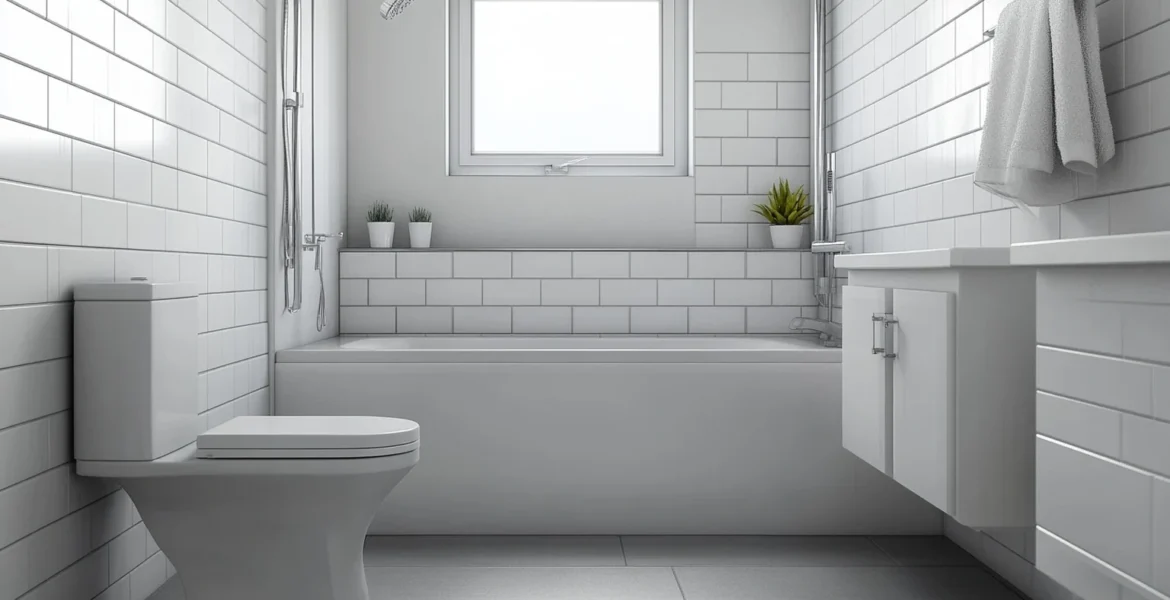
Rental Property Bathroom: What Landlords Should Fit
A rental property bathroom has a different job from one in an owner-occupied home. It has to look good enough to let the property quickly, survive tenants who did not choose the fittings, and cost as little as possible in call-outs between tenancies.
Those three requirements pull in the same direction more often than people expect. The specification that lasts is usually also the one that shows well and costs least to maintain, which makes this an easier brief than it first appears.
Durability Is the Whole Specification
The instinct with a rental property bathroom is to fit the cheapest thing that looks acceptable. That is usually a false economy, because the cost of a plumber attending a tenanted property twice dwarfs the saving on a tap.
The better approach is to spend where failure is expensive and save where it is not. A quality thermostatic shower valve, a solid brass tap and a well-made toilet mechanism cost more once. A budget vanity unit that looks the same in photographs costs nothing extra in call-outs.
Every fitting in a rental property bathroom should be a current, widely stocked model. When something fails in three years, you want a part available the same day, not a discontinued item requiring a full replacement.
What Tenants Actually Notice
Prospective tenants judge a bathroom in about ten seconds, and they are looking at cleanliness, light and whether the shower looks decent. They are not counting grout lines.
A bright, neutral, well-lit bathroom with a proper shower lets faster than a stylish one with a bath shower mixer and a dim light. Getting those basics right does more for void periods than any finish.
Storage matters more than landlords assume. A bathroom with nowhere to put anything ends up with bottles around the bath, which photographs badly at the next letting and encourages the room to be treated carelessly.
Surfaces that survive
Full height tiling in the shower area and at least a splashback elsewhere is the sensible baseline. Painted walls in a wet area will need redecorating between tenancies, every time.
Large format tiles reduce grout lines, which is the single biggest maintenance win available. Grout is what discolours, and less of it means the room looks clean for longer with less effort.
For floors, quality vinyl or rigid core flooring is worth serious consideration over tile in a rental property bathroom. It is warmer underfoot, more forgiving of movement, considerably cheaper to replace between tenancies, and it does not crack if something heavy is dropped.
Sealant is the small item that disproportionately affects how a bathroom shows at viewings. Silicone around a bath or tray discolours within a couple of years in any household, and in a let with back-to-back tenancies it is often the first thing a prospective tenant notices. Budget to cut it out and replace it between tenancies rather than trying to clean it. It is an hour of work and it makes an older bathroom read as cared for.
Ventilation is the highest-value item
In any rental property bathroom, if there is one thing to spend money on, it is extraction. Most damp and mould disputes between landlords and tenants trace back to inadequate ventilation, and those disputes are expensive in time as well as money.
A properly sized fan, ducted correctly to outside, with an overrun timer and ideally a humidity sensor, prevents the problem rather than arguing about it later. A humidity-controlled fan runs when the room actually needs it rather than relying on someone leaving a switch on.
Duct the fan through the wall or roof, never into a loft. Keep the run short and straight. This is the least glamorous line on the quotation and the one that saves the most.
Showers and hot water
A thermostatic shower valve is the right choice in any rental, and in a property with vulnerable tenants it is close to essential. It holds temperature steady and shuts off if the cold supply fails.
Electric showers have a real place in rentals, particularly in HMOs where several people may shower at similar times. They run independently of the boiler, so one failure does not remove everyone’s shower.
Whatever is fitted, keep the model common and the isolation valves accessible. A shower that can be swapped in an hour is worth more than one that requires the tiling to come off.
Bath or shower is a question landlords ask constantly, and the honest answer depends on the letting market. Family lets and properties aimed at longer tenancies benefit from a bath, because families with young children rule out properties without one. Studio and professional lets in city areas rarely need one, and a proper walk-in shower shows better and takes less space. Where a single bathroom serves a family property, a bath with a good thermostatic shower over it remains the most flexible answer.
HMOs and shared houses
A house in multiple occupation has additional requirements, including minimum amenity standards covering how many bathrooms and WCs are provided for a given number of occupants. Those standards are set locally, so the figures vary by council.
Licensing requirements also vary. Mandatory licensing applies to larger HMOs across England, and many councils operate additional or selective licensing schemes covering smaller properties.
Confirming what applies to a specific property is the landlord’s responsibility, and the local authority is the authority on it. The GOV.UK guidance on HMO licensing is the starting point, and your council’s housing team will hold the local amenity standards.
Safety obligations that touch the bathroom
Electrical safety in rented homes in England requires periodic inspection of the installation, with a report provided to tenants. Bathroom electrics, being in a restricted location, are exactly where inspectors look hardest.
Any new circuit for a shower, fan or shaver socket is notifiable work needing certification, and those certificates should be kept with the property file rather than lost between managing agents.
Water systems also warrant a Legionella risk assessment, which for a typical domestic let is a straightforward exercise but is not optional. Long void periods with water standing in pipework are the usual risk factor, and flushing outlets before a new tenancy addresses most of it.
Specifying for the next ten years
The most useful mindset for a rental property bathroom is to imagine the room five tenancies from now. Which parts will still look acceptable, and which will have been replaced twice?
Neutral finishes age better than fashionable ones, not because they are more attractive but because they do not date visibly. White sanitaryware, chrome brassware and a mid-tone floor will look current far longer than the trend of the moment.
Keep a simple record of what was fitted: models, finishes, where the isolation valves are. It makes every future repair faster and cheaper, and it transfers with the property if you sell or change agent.
Speak to AV Modern Bathrooms
If you are specifying a rental property bathroom, we can advise on fittings that stand up to tenant use and stay easy to maintain, and plan the ventilation and electrics properly from the start.
You can see completed projects in our gallery, read more about our bathroom renovation service, or check the areas we cover.
To discuss a property, contact AV Modern Bathrooms.